
Jadau Kundan
A technique unchanged for four hundred years. A piece that took six months to make.
The Inspiration
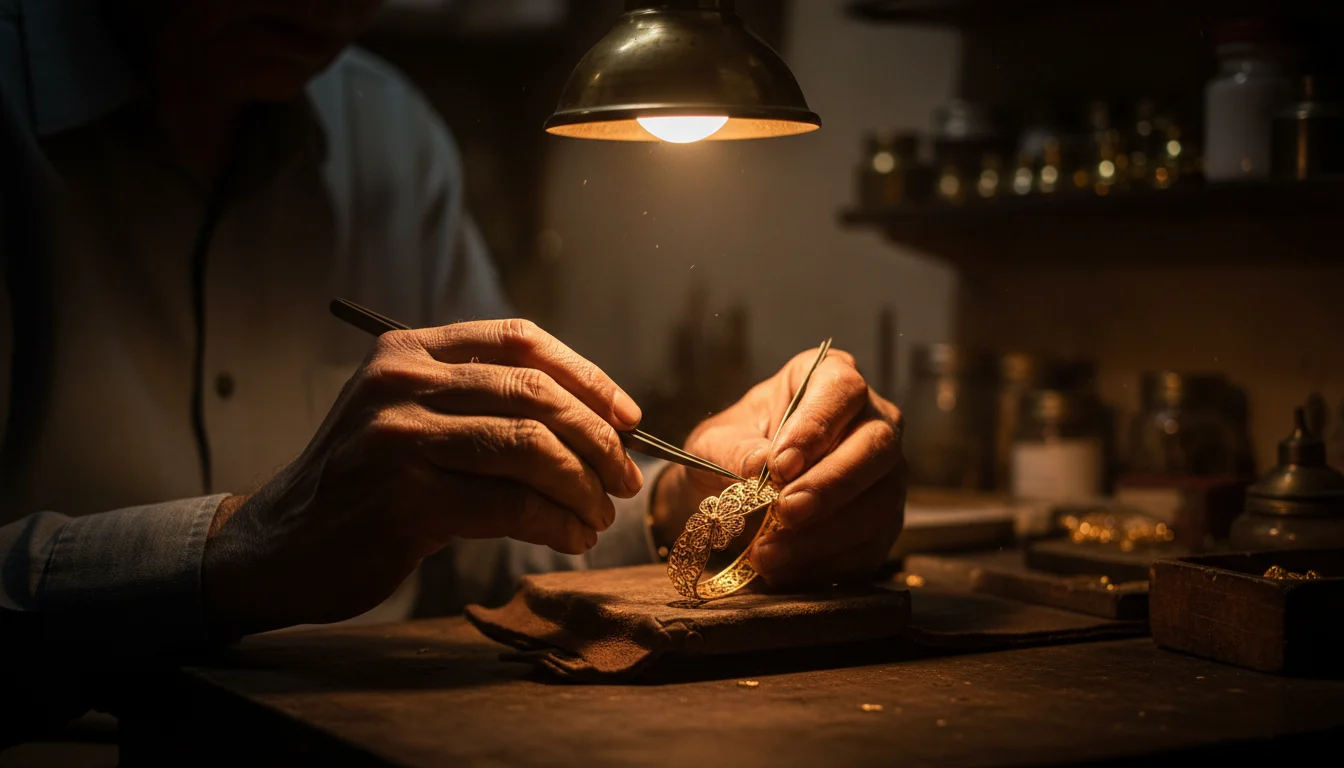
Jadau is the technique. Kundan is the gold. Together, they form the most labour-intensive jewellery tradition in India — uncut stones set into purified 24K gold foil, layered over a 22K base, with no glue, no prongs, and often no welds. Our Jadau Kundan collection is handcrafted by master artisans whose families have done this work for generations. Each piece can take three to six months. Most pieces last lifetimes.
A Jadau Kundan haram with central uncut diamond, emerald and ruby cabochons set in 24K gold foil over a 22K gold base, finished with hand-painted Meenakari on the reverse and traditional gold beadwork at the tassels. Designed in our atelier, crafted over four months in our workshop.
A Jadau Kundan haram with central uncut diamond, emerald and ruby cabochons set in 24K gold foil over a 22K gold base, finished with hand-painted Meenakari on the reverse and traditional gold beadwork at the tassels. Designed in our atelier, crafted over four months in our workshop.
Signature Piece
The Essence of Jadau Kundan
Jadau is the technique. Kundan is the gold. Together, they form the most labour-intensive jewellery tradition in India.
"The stones don't move because of glue or prongs. They don't move because the gold itself holds them — that's the difference."
The Collection
Explore Jadau Kundan
Each piece invites you to discover its story. Select any piece to enquire.
Meher Piece 1
Meher Piece 2
Meher Piece 3
Meher Piece 4
FAQ
Common Questions
What is the difference between Jadau and Kundan?
In Indian fine jewellery:
- Kundan (meaning purified gold) is a technique where layers of pure 24K gold foil are pressed around the edges of a gemstone using special tools. Because pure gold is soft, it conforms tightly to the stone’s shape, creating a secure hold without prongs or claws.
- Jadau is the master craft of heating, framing, and assembling the gold frame (22K base) and setting the gemstones into a bed of natural adhesive (lac), which is then sealed with Kundan.
Why does a Jadau Kundan piece take 3 to 6 months to handcraft?
A single piece is passed between multiple master artisans:
- Chiteras design and construct the gold frame (`ghat`) in 22K gold.
- Ghaarias engraving details and add the natural lac.
- Jadigas set the uncut diamonds (Polki) or gemstones using refined 24K gold foil (Kundan).
- Meenakars paint and bake traditional enamel colors (Meenakari) on the reverse side.
What is the Meenakari work found on the reverse side of Jadau Kundan pieces?
Historically, royal jewellery was decorated on both sides. The front features the glittering Kundan stone setting, while the back displays hand-painted Meenakari enamel, depicting floral, bird, or geometric designs. This not only makes the piece reversible in some designs but also ensures the metal feels smooth and does not snag on bridal silk sarees or lehengas.
Are the uncut diamonds (Polki) in Jadau Kundan jewellery graded like standard brilliant-cut diamonds?
Because Polki stones are not faceted or polished, traditional grading scales (VVS, VSI, etc.) do not apply to them. Instead, they are appreciated for their unique, raw, glass-like transparency, internal inclusion patterns, and origin. We provide certificate documentation that details the total weight of the Polki stones used and verifies their natural, untreated origin.
How can I identify genuine Jadau Kundan jewellery from synthetic imitations?
To verify authenticity, look for the following:
- BIS Hallmark & HUID: Real Jadau pieces will carry a laser-engraved Hallmark Unique Identification (HUID) code verifying the gold purity.
- Reverse detailing: High-quality Jadau pieces always feature hand-painted, kiln-fired Meenakari work on the reverse. Fake pieces often use cheap stickers or painted plastics on a base metal like brass.
- Stone placement: Real Kundan uses pure gold foil to wrap each stone. Imitations use chemical glue or claw-prongs that are gold-plated.
Private Viewing
See Jadau Kundan in Person
Visit our showrooms to experience the full beauty of the Jadau Kundan Collection.